Water Damage
There Is Water In The House. Here Is What To Do.
Call first and read second. We answer live and talk you through the shutoffs while the truck is loading. Everything below is what we would tell you on that call anyway.
Free inspection on restoration work · Licensed C-10 & General B · Answered 24/7
The first ten minutes, before anybody arrives.
In order. If you only get through the first two, that is fine, we will do the rest.
- 01
Kill the water
Main shutoff is usually where the supply enters the house: garage wall, a side yard box near the street, or under the kitchen sink in older Peninsula homes. Turn it clockwise until it stops. If the source is a fixture, its own angle stop under the sink or behind the toilet is faster.
- 02
Kill the power to that area
At the breaker panel, not at the outlet. Never walk into standing water to reach a panel, and never touch a panel with wet hands or wet feet. If the panel is in the flooded area, stop and call us and we will handle it.
- 03
Photograph before you move anything
Wide shots of each affected room, then close shots of the source, the water line on the wall, and every damaged item. This takes two minutes and it is the single most valuable thing you can do for your claim. Nobody can photograph it later.
- 04
Lift what you can, leave what you cannot
Get furniture legs onto foil or blocks, lift rugs off hardwood, move electronics and paper up. Do not start pulling up carpet or cutting drywall. Material that comes out is a decision the meter makes, and an adjuster wants to see it in place.
- 05
Do not throw anything away
Not the ruined rug, not the failed supply line, not the burst hose. The failed part is the evidence of what happened and the reason the loss reads as sudden rather than gradual. Bag it and set it aside.
What the first four hours look like.
You call and somebody picks up, not a service that takes a message. On the phone we work out whether the water is clean, grey, or contaminated, because that decides what the crew brings and what they are allowed to save. If the shutoff has not been found yet, we stay on the line until it has.
The truck arrives with extraction, air movers, and dehumidifiers on board, not after a second trip to a rental yard. The first thing that happens on site is measurement: a moisture meter on affected and unaffected material to establish the baseline, and a thermal camera to find the water that has already travelled somewhere nobody would look for it.
Then standing water comes out, the affected circuits get assessed by our own licensed electrician, and equipment goes in where the readings say it needs to go. Before the crew leaves, you get the day-one photo set and the first moisture map, and so does your adjuster if a claim is open.
Extraction on hour two is a drying job. The same loss on day four is a demolition job, and the difference is measured in walls, floors, and how much of it your deductible has to absorb.
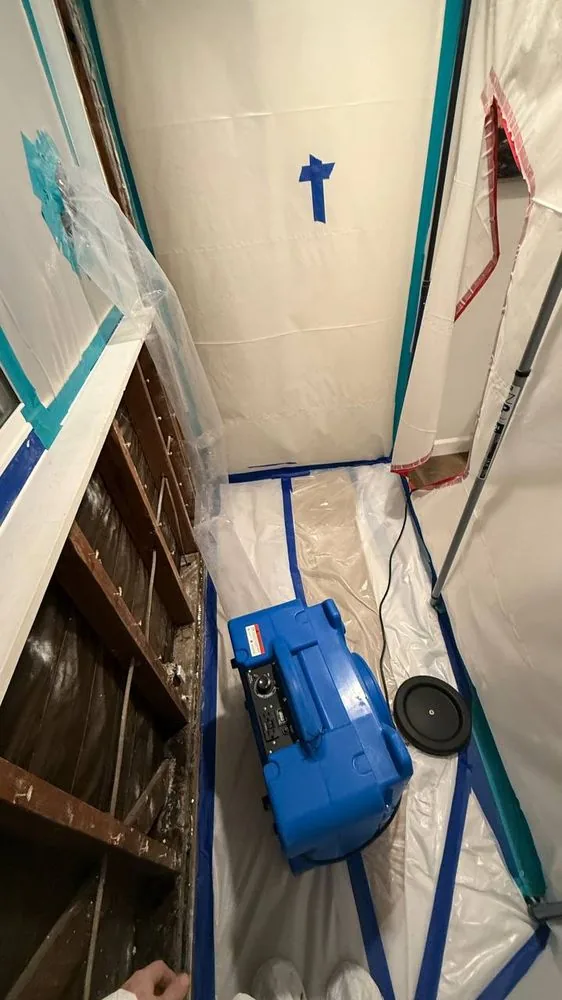
Containment up, wall opened, air movers in. Rebuilt by the same crew.
Who pays, and for what.
General shape of a standard California homeowners policy. Yours is the one that governs, so read it or ask your agent. We are contractors, not adjusters, and we will not tell you what your policy says.
Sudden and accidental is the phrase that matters
A supply line that lets go, a water heater that splits, a dishwasher hose that fails. Standard homeowners policies are written for exactly this, and mitigation is normally covered. This is why the failed part should not go in the trash.
Slow seepage is usually excluded
A pinhole that dripped inside a wall for months is the common denial. Sometimes the resulting sudden collapse is still covered where the seepage itself is not, which turns on wording specific to your policy. We document what we find rather than characterize it for you.
Rising water is a separate policy
Creek and storm water entering at ground level is flood, and flood is not part of a standard homeowners policy anywhere in California. It needs NFIP or private flood coverage. Sewer backup usually needs its own endorsement too.
Your deductible is yours
It applies once per claim and it is the part we will never discount, absorb, or quietly work around. In California that is insurance fraud, and any contractor who offers it is telling you what else they are willing to do.
Mitigation and reconstruction are usually paid as two separate pieces of the same claim, which is worth knowing when a mitigation-only company hands you off. Because we hold the General B license as well, both halves sit on one scope and one schedule. How we document a claim.

Hold Anybody To This
Six ways to spot a bad drying job.
Including ours. If we do any of these on your property, say so and we will fix it.
Equipment arrives without anybody taking a moisture reading first. If nothing was measured on day one, there is no way to prove anything dried later.
Nobody opens a wall and nobody explains why not. Sometimes leaving it closed is right. It should be a decision with a reading behind it, not an omission.
Fans but no dehumidifiers. Air movement without dehumidification moves moisture into the next room and into the ceiling.
No daily log. A drying job with no dated readings is the version of the job carriers question and homeowners cannot audit.
A number quoted over the phone before anybody saw the loss. Nobody can scope a water loss from a description of it.
An offer to "take care of" or "work with" your deductible.
What people actually ask at 2 a.m.
Next on the same job.
24/7 Emergency Response
Every hour the water sits, the job gets bigger and the bill moves.
Licensed C-10 & General B · CSLB #1158693 · Bonded & Insured