Structural Drying
Nine Loud Machines In Your House. Here Is What Each One Does.
Drying is the part of a water loss you have to live with, so it is worth understanding. What the equipment is, how long it stays, whether you can sleep here, and who decides it is finished.
Free inspection on restoration work · Licensed C-10 & General B · Answered 24/7
What all of that equipment is.
Every piece is placed for a reason, and moving one changes the result. If something is genuinely in your way, tell the crew and it gets resolved properly.
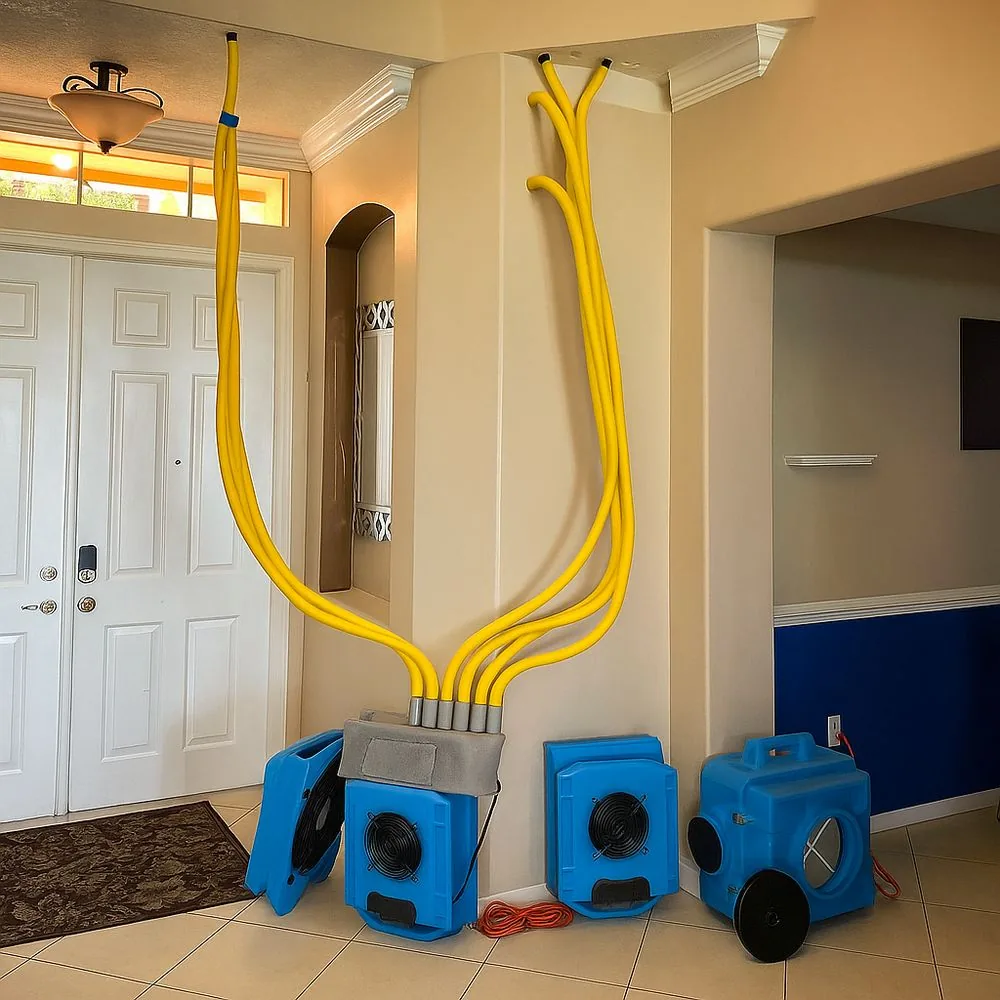
Air movers
The low flat ones aimed along the wall at a shallow angle. They are not there to cool the room. Moving air strips the saturated boundary layer off a wet surface so evaporation can keep going, which is why the angle matters and why moving one to point at yourself sets that wall back.
LGR dehumidifier
The heavy one with a hose running to a drain or a bucket. Low grain refrigerant means it can pull moisture out of air that is already fairly dry, which is the part of the job cheap rental units cannot finish. This machine is what actually removes water from your house.
Heat, on purpose
Warmer air holds more moisture, so the equipment deliberately raises room temperature to move water out of materials and into air the dehumidifier can then strip. If the house feels warm and dry, that is the process working rather than something set wrong.
Injection and mat systems
Used under hardwood, inside wall cavities, and beneath cabinet kicks. Panels or mats seal to the surface and pull air through the assembly itself, so a floor or a wall can dry in place instead of being demolished to reach the wet side.
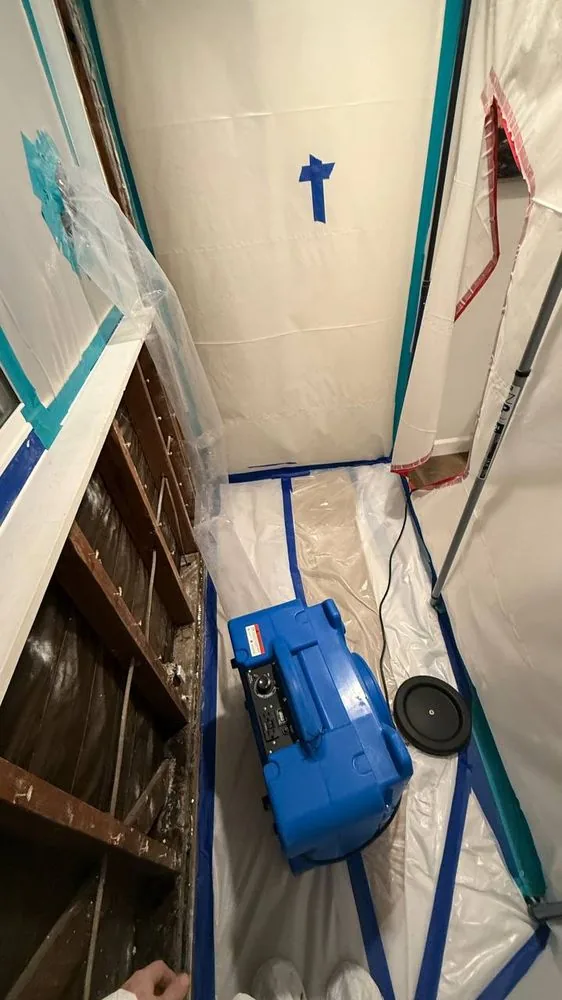
Containment sheeting
Plastic and zippered doorways. It keeps the drying volume small enough to actually dry, and on anything with a contamination or mold question it keeps that area under negative pressure so nothing migrates into the rest of the house.
The meter and the camera
A pin or pinless moisture meter for the numbers, a thermal camera for finding water that has travelled. The camera does not see moisture, it sees the temperature difference evaporation creates, which is why it points us where to measure rather than replacing the measurement.
Why a room full of fans makes things worse.
Air movers do not dry anything. They move water out of the material and into the air, and that is the whole of their contribution. If nothing then takes the moisture out of the air, that air finds the next cold surface and gives it back, which is usually the ceiling, the far wall, or the inside of a closet nobody opened.
This is exactly how a homeowner with rented fans turns a wet bathroom into a mold problem in a bedroom. The moisture was never removed from the building. It was redistributed to somewhere with no fan pointed at it.
The dehumidifier is the half that finishes the job, and it has to be sized to the affected volume. That sizing calculation is the actual craft in structural drying, and it is why the machine count is not arbitrary.
Movement and dehumidification together. Either one alone is not drying.
What the days look like.
Three to five days on a typical residential loss. Saturated hardwood, plaster, or a loss across two floors runs longer, and we would rather tell you that on day two than on day five.
- Day 1
Baseline and setup
Affected and unaffected readings taken and recorded, extraction finished, equipment placed and counted. You get the first photo set and moisture map the same day.
- Day 2
First honest check
Same points re-read. Numbers should have moved. If a point has not, the equipment gets repositioned or a wall gets opened, because a reading that stalls means the wet side is not being reached.
- Day 3 to 4
Convergence
Most materials come down to standard here. Units that are no longer earning their place come out as they finish, which is also what keeps the mitigation invoice defensible.
- Day 4 to 5
Final readings and out
Last reading matches the dry standard, equipment leaves, and the drying log closes. That log is what goes to the adjuster and what proves the cavity was dry before anybody closed it.
Mitigation is billed the way carriers expect, which includes equipment per unit per day. That is precisely why units come out as they finish rather than all at the end: the log has to show the equipment was necessary for exactly as long as it was there.
Living with the drying
Next on the same job.
24/7 Emergency Response
A wall closed over a reading nobody took is a mold job with a delay built in.
Licensed C-10 & General B · CSLB #1158693 · Bonded & Insured