Fire & Smoke
The Fire Department Left. Nobody Told You What Happens Now.
The first night decides more than most people realize: what gets secured, what gets documented, and what gets ruined by somebody trying to help. Here is the order it goes in.
Free inspection on restoration work · Licensed C-10 & General B · Answered 24/7
The first twenty-four hours.
In order. Most of it is about protecting the claim and the building, because both are easier to lose in the first day than at any point afterwards.
- 01
Do not re-enter to retrieve things
Structure, electrical, and air quality are all unknown until somebody assesses them. If there is something you genuinely need, tell us and we retrieve it under proper conditions.
- 02
Open the claim tonight
Carriers run 24-hour loss lines. ALE generally runs from the date of loss, and the sooner the file is open, the sooner temporary housing is authorized.
- 03
Get it secured and boarded
Openings covered, the structure locked, tarps over the roof if it was opened for ventilation. Policies expect you to prevent further loss, and an unsecured building invites both weather and theft.
- 04
Kill the utilities that need killing
Power to affected circuits and gas to affected appliances, done by somebody qualified. Our C-10 crew handles the electrical side rather than waiting on a separate trade.
- 05
Photograph before anybody touches anything
Every room, every angle, the burned area and the smoke-affected areas that look fine. This set can never be recreated once cleanup starts.
- 06
Start keeping receipts
Hotel, meals, clothing, pet boarding, the drive. All of it is potentially ALE and all of it needs documentation you will not remember to reconstruct later.
Soot is not one substance, and the wrong cloth makes it permanent.
What burned decides the residue, and the residue decides the method. This is the single most common way a cleanable surface becomes a replacement line item.
Dry smoke, fast and hot
Powdery, sits on the surface, and comes off cleanly with the right dry method. It also travels furthest into cavities and cracks, so the room that looks untouched often is not.
Wet smoke, slow and smoldering
Sticky, dense, and strongly odorous. Smears badly if handled wrong, and it is the residue most likely to permanently stain if somebody wipes it first.
Protein residue, kitchen fires
Nearly invisible, discolours paint and varnish, and carries an odor that outlasts every attempt to cover it. Frequently missed entirely by cleaners looking for black marks.
Extinguisher and suppression residue
Dry chemical powder is mildly corrosive and needs removing promptly from electronics and metal. Sprinkler and fire department water is a full water loss layered on top of the fire.
Almost every fire is also a water loss.
Suppression puts hundreds or thousands of gallons into a building in minutes, from above, through ceilings that have just been opened for ventilation. By the time anybody is thinking about soot, that water has been in the subfloor and the wall cavities for hours, and it behaves exactly like any other water loss: it wicks, it travels, and it grows mold on the same 24 to 48 hour clock.
So a fire job that only addresses fire is half a job. Extraction and structural drying start alongside the soot work, not after it, and the moisture readings get logged the same way they would on a burst pipe.
The electrical is the other half nobody schedules. Heat degrades insulation on conductors well outside the burned area, and suppression water sits in junction boxes and panels. Our own C-10 crew assesses and documents that rather than leaving it for whoever does the rebuild to discover.
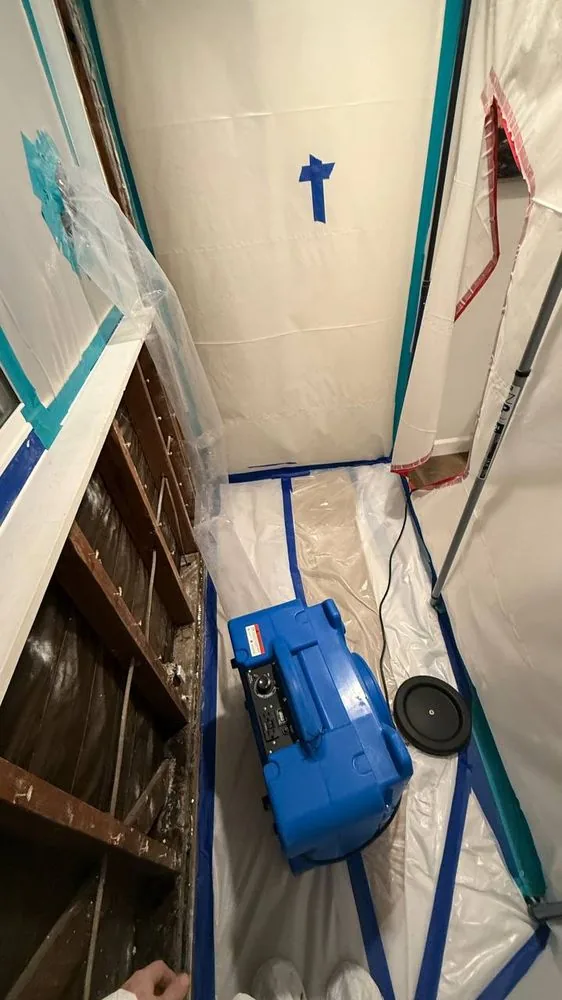
Fire work and drying run together, because the water does not wait.
Fire and smoke questions
Next on the same job.
24/7 Emergency Response
Keep every receipt from tonight. That is the part nobody tells you, and it is worth real money.
Licensed C-10 & General B · CSLB #1158693 · Bonded & Insured