Burst Pipe
Find The Shutoff. Then Call Us.
Everything after the valve can wait a few minutes. The valve cannot. Below is where it usually sits in each kind of Bay Area house, so you are not searching a garage wall with a flashlight while the ceiling fills.
Free inspection on restoration work · Licensed C-10 & General B · Answered 24/7
Where the shutoff is, by kind of house.
Typical locations for this housing stock. Find yours on a dry afternoon and turn it once, so the first time you use it is not in the dark with water rising.
Post-war ranch, 1945 to 1970
Front yard, in a concrete or plastic meter box near the sidewalk. There is usually a second valve on the street-facing exterior wall near the hose bib.
The box lid takes a screwdriver or a meter key. The valve on the house side is yours; the one on the meter side belongs to the utility.
Eichler and slab-on-grade
Exterior wall or the utility closet. There is no crawl space to hide it in, and supply lines run in or under the slab.
Slab construction is why a leak here shows up as a warm patch of floor or a meter that spins with everything off. Radiant heat is a separate system with its own manifold.
San Francisco Victorian and Edwardian
Basement or garage level, on the wall facing the street, usually within a few feet of where the supply comes through the foundation.
These have been re-plumbed in sections over a century, so the valve may be an old gate valve nobody has turned in decades. Turn it slowly.
Condominium or apartment
Inside the unit: a laundry closet, the water heater closet, or behind an access panel in the bathroom. Building mains belong to the HOA and are usually locked.
Shut the unit valve, then call the HOA emergency line. A leak in a stack or a shared wall becomes an association matter, and the sooner that is on record the better.
Anything with a water heater
A cold-water valve sits on top of the heater on the inlet side. Closing it isolates the heater without shutting the whole house.
If the heater itself is the source, close that valve and also cut its power or gas. Electric means a breaker; gas means turning the control knob to off.
Clockwise closes. If it is a lever, a quarter turn crosswise to the pipe is closed. Old gate valves turn many times and can seize or snap, so if one resists, stop and use a fixture stop or the curb valve instead.
Why pipes fail here, where it barely freezes.
Freezing is the national story and it is near the bottom of the list locally. Knowing what actually failed also tells you what else in the house is the same age.
Pinhole leaks in copper
The most common call we take. Copper installed from the 1960s onward develops pinholes from the inside out, and the first sign is often a fine mist inside a wall rather than a drip. Homes on the Peninsula running original copper are now well past the age where this starts.
Street pressure above 80 psi
Parts of the Peninsula and the hill neighborhoods of the South Bay carry high static pressure because the mains have to serve houses uphill. Without a working regulator that load sits on every joint, supply line, and appliance valve in the house, continuously.
Braided supply lines past their life
The flexible connectors behind toilets and under sinks are consumables with a service life measured in years, not decades. A failed one delivers full pressure until somebody finds the valve, which is why so many total-loss floods start in a half bath nobody uses.
Slab leaks
Supply routed under the foundation, common in flat-lot construction across Santa Clara County. The symptoms are indirect: a warm spot underfoot, a water bill that jumped for no reason, the sound of running water with every fixture off.
Brittle CPVC and polybutylene
Used widely in certain build years, both grow brittle with age and tend to fail at the fittings rather than mid-run. When one lets go, the rest of that plumbing is the same age and the same batch.
The rare freeze
Real but limited here, and almost always in the parts of a house that are effectively outdoors: an exposed crawl space, an unheated garage, a hose bib without a frost-proof valve, or an attic run in the Santa Cruz Mountains during a cold snap.
Once the valve is closed, the job is finding where it went.
A pipe that failed inside a wall has been feeding water into a cavity, and cavities connect. Water runs down the back of the drywall, pools on the bottom plate, travels along that plate into the next room, then wicks upward into material that looks perfectly dry from the hallway.
So the first thing that happens is not demolition. It is a thermal camera and a moisture meter working outward from the source until the readings come back to normal, which is what tells us where the wet area actually ends. Opening walls on a guess costs you drywall you did not need to lose.
Pipes and wiring share those cavities. Water in a wall means water around junction boxes, outlets, and sometimes the panel feed, so on the same visit our own C-10 crew assesses the affected circuits and isolates anything unsafe. Most restoration companies have to schedule an electrician for that, which means a second appointment on a live hazard.
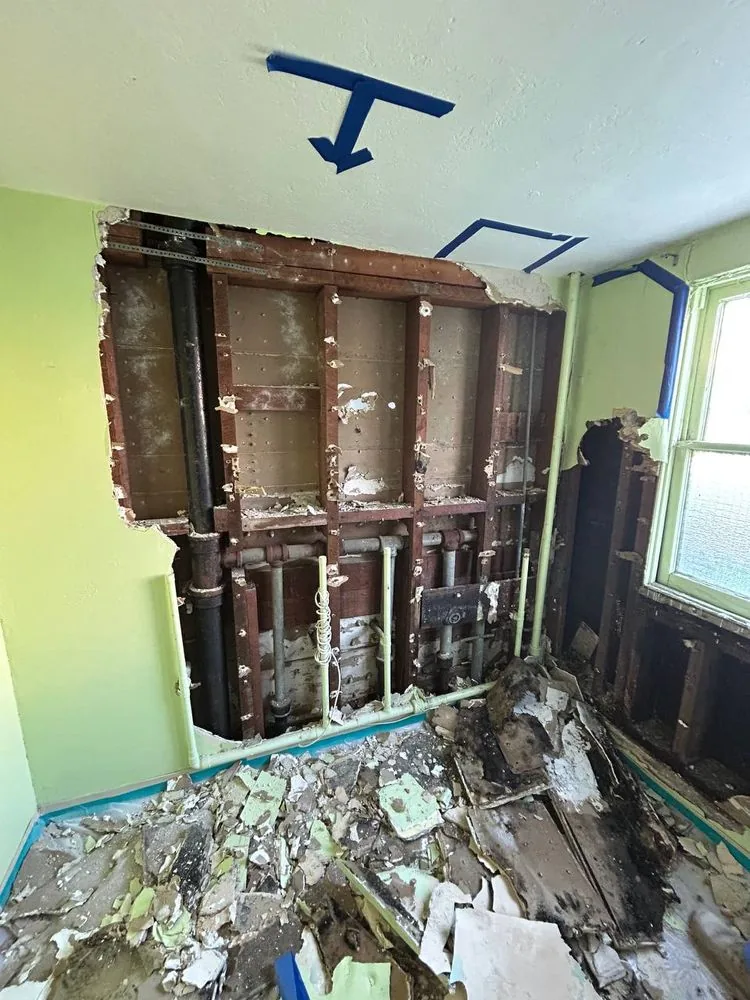
Opened only as far as the readings required, then dried and rebuilt.
Burst pipe questions
Next on the same job.
24/7 Emergency Response
A pipe that failed on a mild night was already failing. The rest of that plumbing is the same age.
Licensed C-10 & General B · CSLB #1158693 · Bonded & Insured